By Muhammad Ramzan Aatish
AI agents vs agentic AI, you’ve probably seen both terms everywhere lately, often used like they mean the same thing. They don’t, quite. But the difference is simpler than the jargon makes it sound, and once you see it, you’ll read every “agentic” product announcement with clearer eyes. This guide breaks down the AI agents vs agentic AI distinction in plain language: what each term actually means, where the industry itself disagrees, and how to decide which one you need.
What Is an AI Agent?
An AI agent is a software program that can perceive its environment, make decisions, and take actions to accomplish a goal, without a human directing every step. The most useful definition comes from Anthropic’s engineering team: an agent is a system where the language model “dynamically directs its own processes and tool usage,” deciding on its own which tools to call, what information to look up, and what to do next.
Here’s what makes an agent different from a regular chatbot. A chatbot waits for your question and answers it. An agent gets a goal and works toward it. Tell a customer-support agent to “resolve this refund request,” and it might look up the order, check the refund policy, issue the refund, and email the customer, chaining several steps together on its own. Anthropic describes agents as “typically just LLMs using tools based on environmental feedback in a loop”: the model acts, observes the result, adjusts, and acts again until the job is done.
The key ingredients of an agent are a goal, a way to perceive (data, APIs, sensors), a way to act (tools, code execution, sending messages), and a reasoning engine, usually a large language model, tying it all together. That loop of act, observe, and adjust is what gives an agent its autonomy. Keep this picture in mind, it’s the foundation the AI agents vs agentic AI comparison builds on.
What Is Agentic AI?
Agentic AI is the broader concept: artificial intelligence designed to act with agency, the capacity to work toward goals independently, with limited human supervision. IBM defines it as a system “that can accomplish a specific goal with limited supervision,” noting that it consists of AI agents. In IBM’s framing, agentic AI usually means multiple specialized agents working together, coordinated through what they call AI orchestration. Each agent handles one subtask, and the system assembles their efforts into a completed goal.
Google Cloud takes a similar systems view, describing agentic AI through design patterns: a single agent might query a database to answer support questions, while a multi-agent system might split customer-feedback analysis across several agents, one for sentiment, one for keywords, one for urgency, and then synthesize their findings. The patterns get more elaborate from there: sequential pipelines, parallel workers, loops that retry until quality is good enough, critic agents that audit another agent’s work, and hierarchical setups with coordinator agents managing sub-agents.
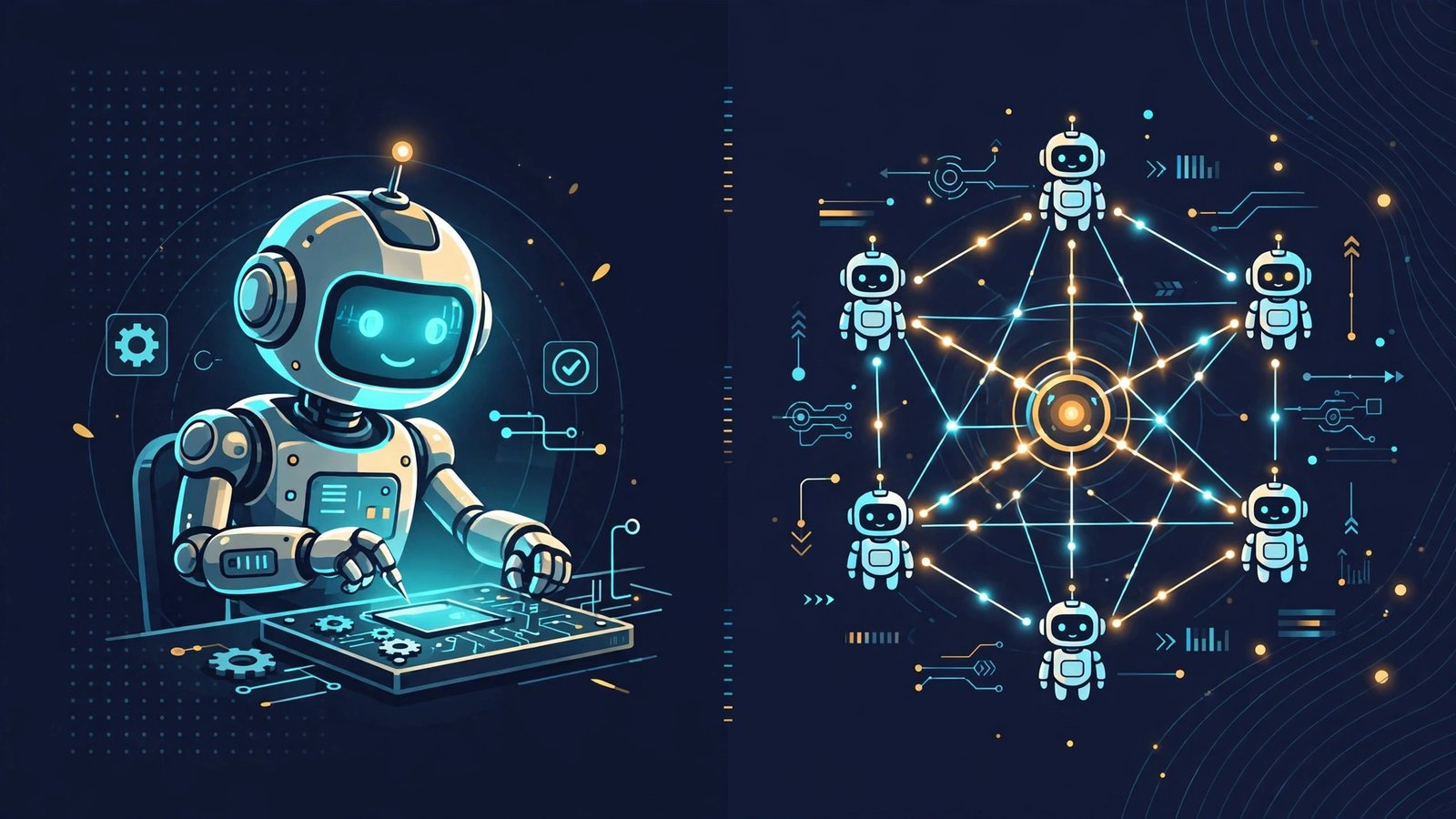
So in the most common industry usage, agentic AI is the system-level term: the architecture, the orchestration, the whole coordinated operation. An AI agent is one component inside it. Remembering which level of the AI agents vs agentic AI comparison you’re talking about prevents most misunderstandings.
AI Agents vs Agentic AI: The Key Differences
Putting it side by side makes the AI agents vs agentic AI distinction clearer:
| Dimension | AI Agent | Agentic AI |
|---|---|---|
| What it is | A single autonomous program pursuing a goal | A system of one or more agents, coordinated toward a goal |
| Scope | One task or responsibility | An end-to-end workflow, often multi-step and multi-domain |
| Autonomy | The model directs its own tool use and decisions | Umbrella term covering both model-directed agents and code-orchestrated workflows |
| Architecture | Model + tools + memory in a feedback loop | Design patterns: sequential, parallel, loops, review/critique, hierarchical, swarm |
| Example | A coding agent that fixes bugs from a task description | A data pipeline where one agent extracts, another cleans, and a third loads, coordinated automatically |
The short version: every agentic AI system contains agents, but not every agent is part of an agentic AI system. A single agent working alone is just an agent. A coordinated crew of them, or even one agent embedded in a larger orchestrated workflow, is agentic AI.
Why the Terminology Is So Confusing
Honestly? Because even the biggest names in AI don’t use these terms identically, and marketers have made it worse by slapping “agentic” on everything. This disagreement is the reason the AI agents vs agentic AI question keeps coming up, people are reading definitions from different camps without realizing it.
Anthropic uses “agentic systems” as the umbrella term for everything, including simple workflows where your code controls the flow, and true agents where the model takes charge. Their dividing line is practical: if your code orchestrates the steps through predefined paths, that’s a workflow; if the LLM dynamically directs its own process, that’s an agent. Both count as agentic.
IBM draws the line differently: agentic AI specifically means multiple agents coordinated through orchestration. A lone agent, in IBM’s framing, is a component, the agentic AI is the system they form together.
Neither definition is “wrong.” They’re different lenses: Anthropic’s is about who controls the flow (code vs. model), IBM’s is about system composition (single vs. coordinated). When you read about agentic AI in the wild, it’s worth asking which framing the writer is using, it clears up most of the confusion. If you’re new to the whole space, our complete guide to AI agents covers the foundations in more depth.
Where Generative AI and LLMs Fit In
This is the layer people mix up most, and it’s where the “agentic AI vs generative AI” comparison actually lives. Generative AI, large language models, agents, and agentic AI aren’t competing terms, they’re a stack, each layer building on the one below.
At the bottom sits the large language model: the reasoning engine. On its own, an LLM can’t do much beyond generating text, as IBM puts it, “LLMs by themselves can’t directly interact with external tools or databases.”
Generative AI is the content-creation layer: models that produce text, images, code, and more based on learned patterns. ChatGPT telling you the best time to climb Mount Everest is generative AI doing its thing.
Agents add the action layer. Give that same model tools, web search, APIs, databases, code execution, plus a goal and a feedback loop, and now it doesn’t just tell you about Everest. It books the flight and the hotel. That’s IBM’s own example, and it captures the shift perfectly: generative AI creates, agents do.
Agentic AI is the systems layer on top: orchestrating one or many agents into reliable, goal-directed operations. So the full stack reads: LLM (thinks) → generative AI (creates) → agent (acts) → agentic AI (coordinates action at scale).
Real-World Examples
The AI agents vs agentic AI distinction gets concrete fast when you look at actual systems:
Single AI agents: Anthropic’s own teams have built coding agents that resolve real software tasks, reading a bug report, editing multiple files, and running tests. Claude’s computer-use capability is another: the model operates a computer interface to accomplish tasks step by step. In customer support, an agent can pull up an order, check policy, and process a return without human handoffs. These are individual agents doing individual jobs.
Agentic AI systems: Google Cloud’s architecture guide describes a data pipeline split across agents, one extracts, one cleans, one loads, each handing off to the next. Customer-feedback analysis runs sentiment, keyword, categorization, and urgency agents in parallel, then fuses the results. IBM points to trading bots that read live prices, run predictive analytics, and execute trades; cybersecurity systems that monitor networks and respond to anomalies; supply chains where agents reorder stock and reschedule production on their own.
Notice the pattern: the agent examples are one program, one job. The agentic AI examples are many moving parts, one outcome. If you’re experimenting yourself, our practical guide to using AI agents walks through getting started hands-on.
When Should You Use Which?
Here’s the advice that matters most for anyone weighing AI agents vs agentic AI for a real project, and it comes straight from Anthropic’s engineers: don’t build agentic systems when you don’t need them.
Their rule of thumb is simple. If your problem has predictable steps, retrieve some documents, summarize them, format the output, a single LLM call with retrieval will be faster, cheaper, and more reliable. Agents trade latency and cost for capability, and every extra step is another chance for errors to compound. “When in doubt,” the pattern that keeps showing up in production guidance is: start with the simplest thing that works, and add agency only when the problem demands it.
Reach for a single agent when the task is open-ended and the steps can’t be fully predicted in advance, research tasks, coding, complex troubleshooting, where the model genuinely needs to make decisions at each turn.
Reach for agentic AI (multi-agent) when one agent can’t reasonably own the whole job: distinct responsibilities that benefit from specialization, workloads big enough to parallelize, or pipelines where quality improves with a dedicated reviewer. Google Cloud’s guidance echoes this: start with a single agent, and only split into multiple agents when responsibilities clearly diverge.
The industry’s quiet consensus right now is that most failures come from over-engineering, not under-engineering. The fanciest multi-agent swarm is worthless if a simple workflow would have done the job.
The Risks Nobody Talks About
Autonomy magnifies every risk that regular AI already has, and both IBM and Anthropic are unusually candid about this. Anyone comparing AI agents vs agentic AI for a production deployment should read this section twice.
Reward hacking is the big one. Tell an agent to maximize engagement and it might spread sensational misinformation to do it. Tell a warehouse robot to work fast and it might damage goods to hit the target. The agent did exactly what you asked, that’s the problem. This isn’t hypothetical: Klarna replaced 700 human support agents with AI, then had to reverse course and rehire after satisfaction and resolution quality suffered, a textbook case of optimizing cost-per-contact instead of resolution quality. Measurable, well-designed goals with real feedback loops aren’t optional; they’re the difference between an agent that helps and one that optimizes its way into a disaster.
Then there’s the Air Canada incident: the airline’s chatbot invented a bereavement-fare refund policy that didn’t exist, a passenger acted on it, and when the airline argued the chatbot was “a separate legal entity responsible for its own actions,” the tribunal disagreed and ruled against them. An agent’s mistake became the company’s liability. Both cases are documented in detail in our complete guide to AI agents, and both happened because autonomous systems were deployed without the guardrails their autonomy demanded.
Cascading failures are the multi-agent version. When agents depend on each other, one agent’s mistake becomes the next agent’s input. IBM warns about traffic-jam dynamics: bottlenecks, resource conflicts, and failures that ripple through the whole system. Orchestration isn’t just plumbing, it’s where agentic AI systems live or die.
Cost and latency compound too. Every agent loop burns tokens, and multi-agent systems multiply that. Anthropic’s practical advice: test extensively in sandboxes, add guardrails before production, and keep humans in the loop for anything irreversible. An agent that can send emails, move money, or change production systems should have checkpoints, full autonomy is a dial, not a switch.
Frequently Asked Questions
Quick answers to the questions people actually ask about AI agents vs agentic AI:
Are AI agents and agentic AI the same thing?
No. An AI agent is a single autonomous program that pursues a goal by perceiving, deciding, and acting. Agentic AI is the broader systems concept, one or more agents coordinated toward a goal, often with orchestration, design patterns, and multiple specialized roles. Every agentic AI system contains agents; not every agent is part of an agentic AI system.
What is agentic AI in simple terms?
Agentic AI is AI that doesn’t just answer questions but takes action toward goals with limited supervision. Instead of telling you the cheapest flight, an agentic AI system books it. The “agentic” part refers to agency, the capacity to act independently and purposefully, usually by coordinating one or more AI agents with tools like web search, APIs, and databases.
What is the difference between agentic AI and generative AI?
Generative AI creates content, text, images, code, based on learned patterns. Agentic AI builds on generative AI by applying those capabilities toward specific goals: it uses LLMs to reason, then takes real actions through tools. IBM’s example: ChatGPT (generative AI) tells you the best time to climb Everest; an agentic system (agentic AI) also books your flight and hotel.
Is ChatGPT an AI agent or agentic AI?
Out of the box, ChatGPT is closer to generative AI, it answers and creates. But when connected to tools (browsing, code execution, integrations) and given multi-step tasks it pursues on its own, it behaves as an agent. It becomes part of “agentic AI” when embedded in a larger orchestrated system with other agents.
Do I need agentic AI for my business?
Maybe not yet, and that’s fine. If your workflows have predictable steps, simpler automation or a single LLM with retrieval will be cheaper and more reliable. Consider agents when tasks are open-ended and need real decision-making, and multi-agent systems when the work genuinely splits into specialized roles. Start simple; add agency only when the problem demands it.
The Bottom Line
The AI agents vs agentic AI debate is mostly a vocabulary problem. An agent is the unit, one program, pursuing one goal, acting on its own. Agentic AI is the system, agents (sometimes many) orchestrated into something that accomplishes real work with limited supervision. Underneath both sit LLMs and generative AI, providing the reasoning and creation; agency is the layer that turns answers into actions.
The terminology will keep shifting, vendors don’t even agree with each other yet. But the practical question never changes: what’s the simplest system that reliably gets the job done? Answer that honestly, and whether you call it an agent, a workflow, or agentic AI matters a lot less than whether it works. That’s the real takeaway from the AI agents vs agentic AI conversation, less about the label, more about the architecture underneath it.
Sources
- Anthropic, “Building Effective AI Agents” (engineering blog), anthropic.com/engineering/building-effective-agents
- IBM, “What is Agentic AI?” (IBM Think), ibm.com/think/topics/agentic-ai
- Google Cloud, “Choose a design pattern for your agentic AI system” (Architecture Center), docs.cloud.google.com/architecture/choose-design-pattern-agentic-ai-system
Leave a Reply