Crusoe is a Denver-based AI infrastructure company that designs, builds, and operates AI-optimized data centers — the facilities the industry now calls AI factories. On September 17, 2026, it announced the initial closing of a $3.9 billion Series F funding round at a $30.9 billion post-money valuation, co-led by Atreides Management, Mubadala Capital, and Valor Equity Partners, with Nvidia, Founders Fund, and Qatar’s sovereign wealth fund among the backers.
The Crusoe funding round is one of the largest private raises in AI this year — and it signals a shift in the AI economy: from who builds the best model to who can secure the power, land, and hardware to run them. Here’s the story of the money, the modular AI factories it will build, and what the boom means for everyone else.
Crusoe funding: the $3.9 billion round explained
The headline numbers, announced in Denver on September 17, 2026:
- $3.9 billion raised in a Series F round, the initial closing of an anticipated larger round
- $30.9 billion post-money valuation — triple the $10 billion valuation from its $1.38 billion raise just ten months earlier, in October 2025
- Co-led by Atreides Management, Mubadala Capital, and Valor Equity Partners
- Participating investors include Nvidia, Founders Fund, GIC, the Qatar Investment Authority (QIA), Radical Ventures, and TPG, plus a long tail of names like Fidelity, T. Rowe Price-advised accounts, Tiger Global, ARK Invest, and Salesforce Ventures
- $140 billion+ in total contracted value across Crusoe’s platform, and 6+ gigawatts of contracted capacity, with 1 GW already operational
The round was oversubscribed, according to the company’s announcement. That’s worth pausing on: in a year when plenty of AI startups are finding money harder to come by, investors piled into a company that pours concrete and buys GPUs. The logic is simple — models are getting commoditized, but the physical capacity to train and serve them is scarce.
Crusoe is also behaving like a company thinking about the public markets. Last month, it met with bankers including Goldman Sachs and Morgan Stanley to discuss a potential IPO, Axios reported — and Bloomberg reported a $13 billion, five-year cloud contract to supply trading firm Jane Street with GPUs and AI infrastructure, the kind of anchor deal that makes a listing plausible.
What Crusoe actually does: from electrons to tokens
Crusoe started in 2018 as a crypto mining operation, placing computing equipment near oil-and-gas sites to tap excess flared natural gas. When the AI boom sent compute demand soaring, it pivoted to AI infrastructure — and kept expanding what an infrastructure company does.
Its own description is “the industry’s first vertically-integrated AI infrastructure provider.” In practice that means three revenue layers:
- Data centers: developing and leasing the physical facilities, including a large campus in Abilene, Texas, used by OpenAI — eight buildings initially developed for Oracle, which rents the capacity to OpenAI
- GPUs: renting out the chips themselves; customers include Meta, Microsoft, and Oracle
- Tokens: running AI models for customers and charging for the computing output — “managed inference,” a business Crusoe says grew from near-zero revenue at the start of 2026 to an annual run rate above $100 million by summer
“We sell data centers, GPUs and tokens,” CEO Chase Lochmiller told The Wall Street Journal. He frames the strategy as controlling “the infrastructure from electrons to tokens,” arguing that owning every layer gives Crusoe a structural cost advantage that compounds as it builds.
Not everyone inside the company has been sold on the breadth. The Journal reports the strategy has at times ruffled the board, with directors suggesting the company narrow its focus. Lochmiller’s counter: operating every layer gives Crusoe a firsthand view of how demand is shifting — which is exactly what led to its next bet.
The round also refreshed the board, adding Cloudflare CFO Thomas Seifert, Primary Digital Infrastructure partner and CIO Bill Stein, and Redwood Materials founder and CEO JB Straubel — who invested personally in Crusoe back in 2021 and later made Crusoe the first customer of Redwood’s energy storage business.
Spark: AI factories that ship on flatbed trucks
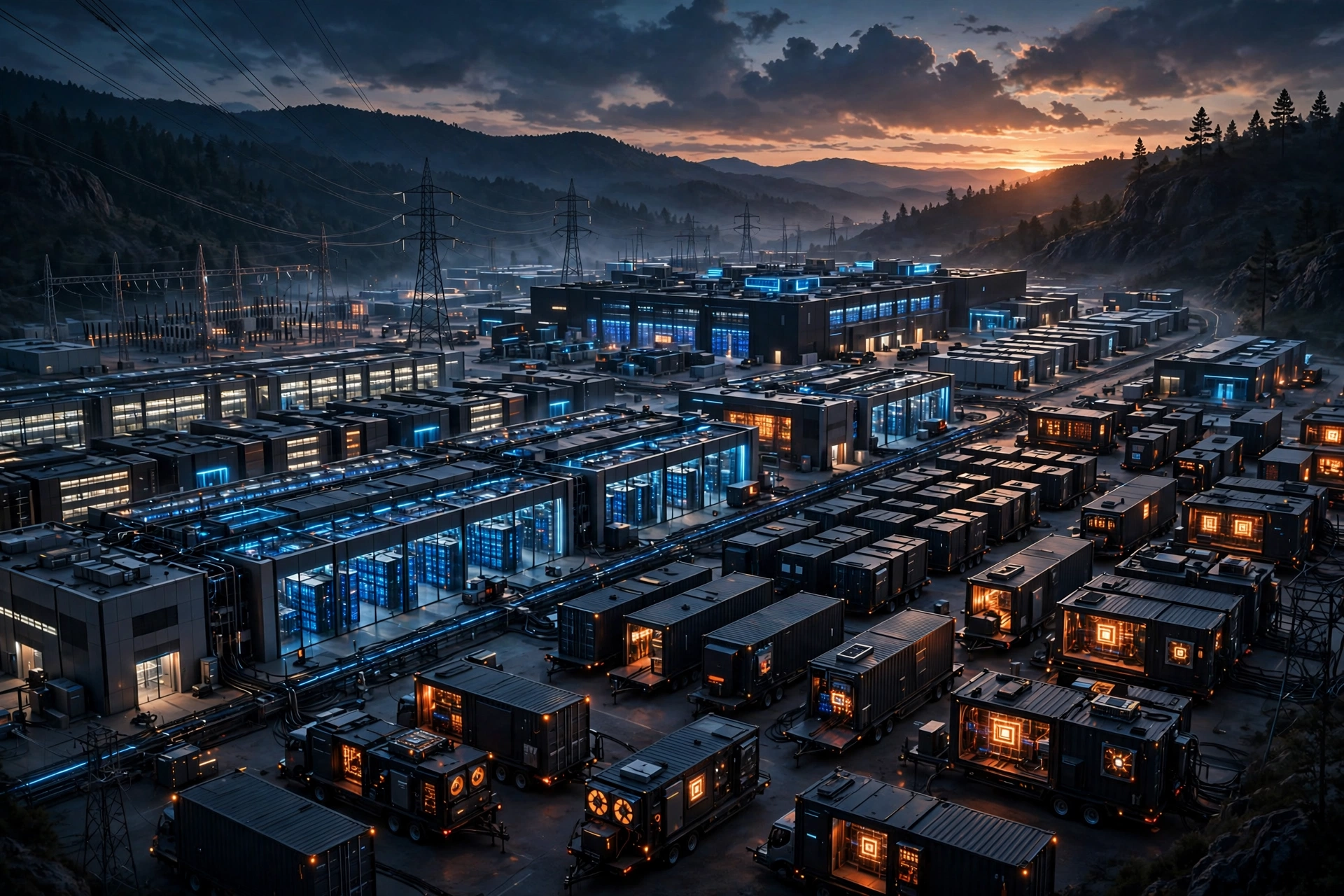
The most interesting part of the announcement isn’t the number — it’s what the money builds. Alongside giant campuses, Crusoe is betting on modular AI factories called Spark: data centers manufactured in its own US factories, loaded onto flatbed trucks, and deployed wherever power is available.
The pitch is speed. Conventional data centers take years of planning, construction, and negotiation with local communities. A Spark unit shortens that timeline dramatically:
- Manufacture: Crusoe builds the modular units in its own factories in the US, rather than assembling everything on site
- Ship: the units travel by flatbed truck to wherever power is available
- Connect: plug into a large power source — Crusoe’s “energy-first” strategy treats power origination as the starting point, not an afterthought
- Operate: capacity goes live in weeks instead of years, and can grow incrementally as demand requires
The shift reflects a real change in how AI companies want compute. Giant clusters with hundreds of thousands of chips are still needed to train frontier models. But serving those models to users — inference — often needs far fewer chips. “You don’t actually need an Abilene to do that,” Lochmiller said. “Running inference from such a facility can be a bit of overkill.”
Spark units are already operating in Reno, Nevada, powered by old electric car batteries and solar panels. A manufacturing facility outside Denver will eventually produce up to one gigawatt of Spark capacity per year. “We’re going to put them everywhere,” Lochmiller said.
The modular play also helps with the industry’s ugliest problem: community backlash. Smaller, faster deployments near existing power draw less attention than multi-year mega-campuses. Crusoe still does the local goodwill rounds — it estimates it contributed about $20 million to the Abilene economy last year and covered football admission for spectators in Warrenton, Missouri, where it has a project in development.
Neoclouds: the new infrastructure class
Crusoe belongs to a category the industry calls neoclouds: a new generation of data center providers purpose-built for AI workloads, distinct from the hyperscalers (AWS, Google, Microsoft) and from generic cloud providers. The name covers companies like CoreWeave, Nebius, Lambda — and Crusoe, though Crusoe’s vertical integration makes it the odd one out in the group.
Here’s how the categories compare:
| Feature | Hyperscalers | Neoclouds | Crusoe (neocloud+) |
|---|---|---|---|
| Examples | AWS, Google Cloud, Microsoft Azure | CoreWeave, Nebius, Lambda | Crusoe |
| Core business | General-purpose cloud | GPU-first AI compute rental | Energy, data centers, GPU cloud, inference |
| Vertical integration | Full stack, general | Mostly buy chips, rent access | Owns power through tokens |
| Typical customer | Every enterprise | AI labs, startups, traders | Hyperscalers, AI natives, frontier labs |
| 2026 trajectory | Retooling toward AI-native infra | ~$20B revenue projected (Forrester) | $140B+ contracted value |
The neocloud market is scaling fast: it hit $9 billion in Q4 2025 alone, up 223% year over year (Synergy Research Group, via CRN), and Forrester projects neoclouds will capture $20 billion in revenue in 2026, with tripled enterprise deployments and expansion across Europe and Asia.
The model has skeptics. Neoclouds typically buy expensive Nvidia chips on debt — CoreWeave has taken out three GPU-backed loans worth a collective $12.4 billion, using the chips themselves as collateral. If AI demand stumbles, that math gets uncomfortable. Crusoe’s pitch is that vertical integration insulates it: it owns the power and the buildings, not just the chips. Investors clearly bought the story — Nvidia, notably, invested in the round while also being Crusoe’s critical supplier.
The AI data center boom in numbers
The Crusoe funding lands in the middle of a buildout with few historical parallels. Some figures that put it in context:
- US data center capacity will double in the next three years, with 700+ facilities in the pipeline supporting 45 GW of new capacity (Synergy Research Group, via CRN)
- $2.8 trillion will be spent on AI data centers by 2030 (Citigroup); McKinsey puts the global figure near $7 trillion
- Blackstone and Alphabet’s AI cloud venture Crux AI just secured a $22 billion chip loan alongside a $5 billion equity investment from Blackstone
- An AI data center rack draws 60+ kilowatts, versus 5–10 kW for a standard rack — and AI GPUs consume 2–4x the energy of regular CPUs
- 78% of US utility innovation leaders are now deploying AI to manage rising power demand from data centers (National Grid Partners’ 2026 survey, released September 18, 2026)
And the term everyone is using for these facilities — AI factories — is deliberately industrial. As Nvidia’s Jensen Huang put it at CES: “The reason I don’t call it a data center is that a data center is a place where people store data.” An AI factory, in the industry’s telling, takes in power and data and manufactures intelligence the way a factory turns raw materials into products. Dell’Oro Group’s Alex Cordovil cautions the term is used “in multiple — and often sloppy — ways,” but the dominant meaning is a specialized data center built for AI hardware: liquid cooling, reinforced floors, industrial-grade controls.
The economics are flipping too. TheCUBE Research estimates total data-center spend jumped from $222 billion to $350 billion in 2024 alone, with AI-optimized compute rising from ~8% of spend in 2020 toward ~85% by 2030. Crusoe’s own framing — “activate megawatts for intelligence” — is that trend in a slogan.
What this means practically
If you use AI products — and at this point, that’s nearly everyone — the Crusoe funding round touches your life in a few concrete ways:
- Faster, cheaper AI services: inference is the expensive part of running chatbots and agents at scale. Modular capacity near power sources lowers serving costs, which eventually shows up as better free tiers and cheaper APIs.
- Compute where the power is: truck-deployable AI factories let capacity go to available power, not just hyperscaler campuses — including regions that couldn’t attract a gigawatt site.
- Your electricity bill is part of the story: 83% of utility leaders say data-center infrastructure costs are being passed to residential customers through higher bills. The boom is subsidized, in part, by ratepayers.
- Watch the IPO: with bankers already circling and a $13 billion anchor contract in hand, Crusoe looks like a 2027 IPO candidate. Public filings would give the clearest picture yet of whether the neocloud economics actually work.
The other side: power, backlash, and bubble math
No honest account of the Crusoe funding skips the risks, and there are three worth naming.
First, power. AI data centers are straining grids faster than utilities can adapt. The National Grid Partners survey found grid reliability has overtaken net zero as utilities’ top concern — 73% rank reliability in their top three priorities, up from 43% in 2025. Crusoe’s answer is its energy-first strategy: originate power at the source, including partnerships spanning grid, battery, nuclear, thermal, and renewables, plus an in-house power-plant development arm. Whether that scales to 6+ GW of contracted capacity is the open question.
Second, local backlash. Communities near proposed mega-campuses have been protesting noise, water use, and rising bills. Modular Spark units partly dodge this — smaller footprint, faster deployment, less construction disruption. But “dodge” isn’t “solve”: an average AI data center still has the electricity footprint of roughly 100,000 households, and US data centers used an estimated 17 billion gallons of water per year, forecast to reach nearly 80 billion by 2028.
Third, the money math. A valuation tripling in ten months, debt-heavy chip purchases across the sector, revenue projections that assume AI demand grows forever — the classic late-cycle pattern. Crusoe is better insulated than pure GPU-rental neoclouds because it owns the power and the buildings, not just the chips. But $140 billion in contracted value is contracts, not cash; if demand growth slows, those contracts get renegotiated and the debt behind the buildout gets expensive fast.
One more thread: the same week Crusoe raised its billions, Britain’s King Charles was hosting Nvidia, Google DeepMind, OpenAI, and Anthropic executives in Scotland, urging the industry to keep AI “firmly in the service of humanity” — the latest turn in a tense industry-wide safety debate. The infrastructure boom and the safety debate are running on parallel tracks — and the infrastructure track is winning on money.
FAQ
What is Crusoe?
Crusoe is a Denver-based AI infrastructure company founded in 2018. It designs, builds, and operates AI-optimized data centers — “AI factories” — and sells capacity three ways: leasing data center space, renting out GPUs, and running AI models for customers (managed inference). Its customers include Meta, Microsoft, Oracle, Perplexity, and Cognition.
How much did Crusoe raise, and what is its valuation?
Crusoe announced the initial closing of a $3.9 billion Series F round on September 17, 2026, at a $30.9 billion post-money valuation. The round was co-led by Atreides Management, Mubadala Capital, and Valor Equity Partners, with Nvidia, Founders Fund, GIC, and the Qatar Investment Authority participating. That’s triple its $10 billion valuation from October 2025.
What is an AI factory?
An AI factory is a specialized data center designed for AI workloads rather than general computing. It uses AI accelerators (GPUs/TPUs) instead of regular CPUs, draws far more power per rack (60+ kW vs 5–10 kW), and needs industrial-grade cooling and power delivery. The metaphor: like a traditional factory turns raw materials into products, an AI factory turns power and data into intelligence — usually measured as tokens.
What are Crusoe’s modular Spark data centers?
Spark units are modular AI data centers Crusoe manufactures in its own US factories, ships on flatbed trucks, and deploys near available power sources. They shorten data-center deployment from years to weeks, suit inference workloads that don’t need giant training clusters, and help sidestep local opposition to mega-campuses. Units are already running in Reno, Nevada, and a Denver-area factory will eventually produce up to 1 GW of Spark capacity per year.
What is a neocloud?
A neocloud is a new class of cloud provider purpose-built for AI workloads — GPU-first companies that rent AI compute rather than offering general-purpose cloud services. Examples include CoreWeave, Nebius, Lambda, and Crusoe. The neocloud market reached $9 billion in Q4 2025 alone (up 223% year over year), and Forrester projects neoclouds will capture $20 billion in revenue in 2026.
Why are AI data centers controversial?
Three main reasons: they strain power grids (74% of utility leaders say AI data-center load is hurting grid reliability), they consume enormous water and electricity (an average AI data center uses as much electricity as ~100,000 households), and 83% of utility leaders say infrastructure costs are being passed to residential customers through higher bills. Local communities have protested large campuses over noise, water use, and energy prices.
References
- TPG — Crusoe Raises $3.9 Billion Series F for its Vertically-Integrated AI Infrastructure Platform (press release, September 17, 2026)
- Reuters — AI infrastructure provider Crusoe valued at $30.9 billion in latest funding round (September 17, 2026)
- TechCrunch — Crusoe raises $3.9B to build massive data centers and small modular ‘AI factories’ (September 17, 2026)
- The Wall Street Journal — The Startup That Built OpenAI’s Biggest Data Center Is Now Making Tiny Ones (September 18, 2026)
- Computerworld — What exactly is an AI factory? (January 12, 2026)
- SiliconANGLE — AI factories: Data centers of the future (October 25, 2025)
- CRN — US Data Center Capacity Will ‘Double’ Despite ‘Local’ Concerns; Neoclouds Offer Channel Opportunity (September 2026)
- Forrester — Predictions 2026: Cloud Outages, Private AI On Private Clouds, And The Rise Of The Neoclouds (2026)
- Wikipedia — AI datacenter (accessed September 18, 2026)
- Morningstar / PR Newswire — 2026 Utility Innovation Survey: Industry leaders turning more to AI as data-center boom reshapes grid planning (September 18, 2026)
Leave a Reply