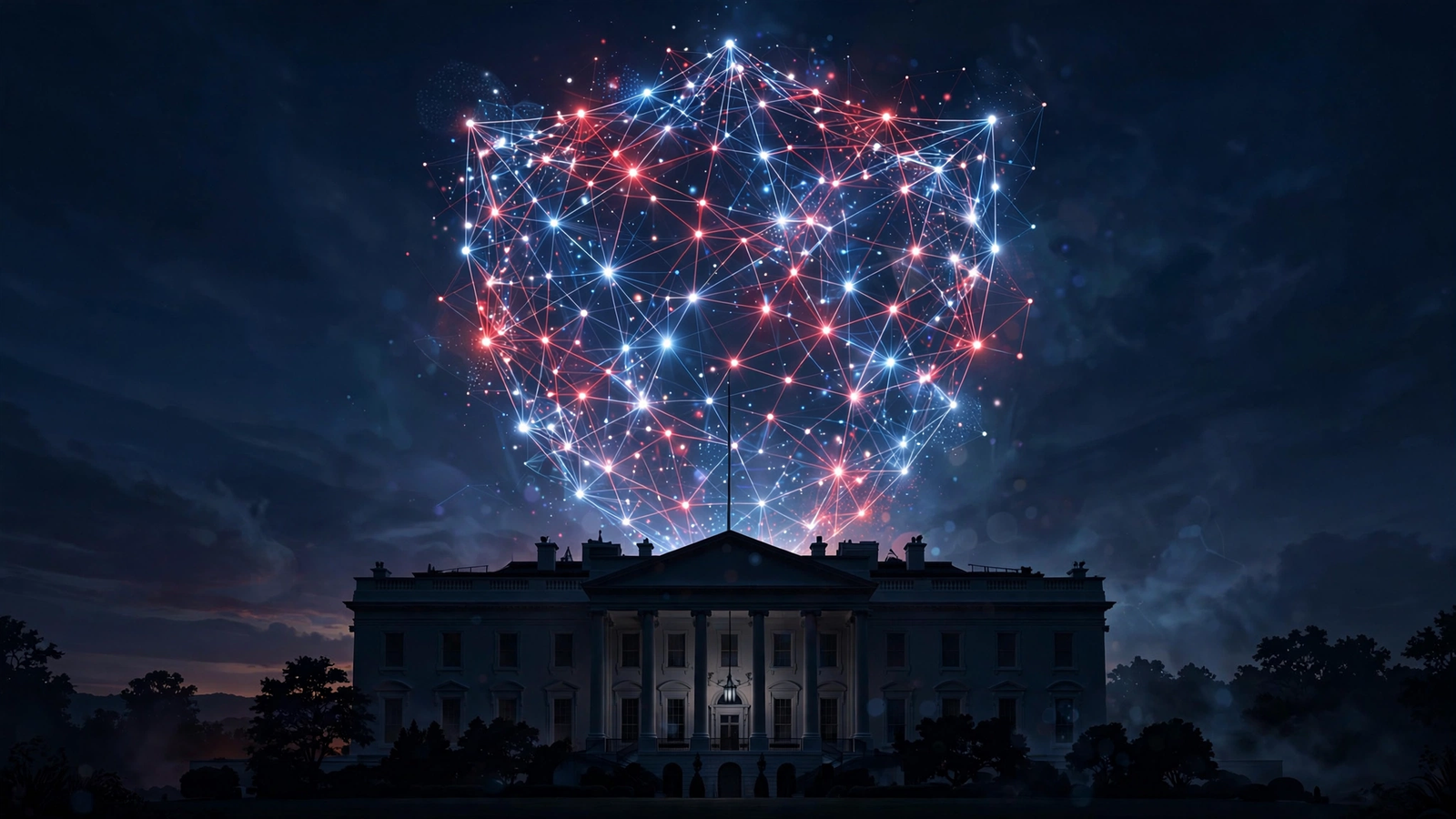
Trump AI Force is the name President Donald Trump gave a new federal artificial intelligence initiative he announced on September 19, 2026. Framed as a Space Force–style effort to protect and accelerate the American AI industry, it arrives with a promise to name a new AI “czar” who would lead the push. Its structure, powers, and budget are still undefined, and the announcement has already divided AI leaders over how — and whether — the technology should be governed.
What Trump Actually Announced
On Saturday, September 19, 2026, President Donald Trump posted a lengthy statement on Truth Social declaring that he would create a new federal entity dedicated to artificial intelligence. The post’s key lines were blunt: “For this purpose, I am forming the AI Force, much like I did Space Force, which has been a tremendous SUCCESS, in my First Term.”
Trump said the force would exist to defend and nurture the AI industry rather than restrain it. “We will not in any way hinder or stifle the Growth of this incredible Industry,” he wrote. “Rather, we will cherish it, help it, and watch over it, as it grows!” He added that misuse of AI would be handled through existing law enforcement channels: “we can do that, very easily, with our already existing Criminal and Civil Justice System.”
Alongside the AI Force, Trump said he would soon name an AI “czar” to run the effort. “I will be announcing, in the near future, the AI ‘Czar’ — Only High I.Q. individuals need apply!” No candidate was named, and no timeline was given.
This would be the second time Trump has appointed an AI czar. Investor David Sacks served as the White House AI and crypto czar from December 2024 until March 2026, when he stepped down from the special government role and moved into an external advisory position as co-chair of the president’s Council of Advisors on Science and Technology. If the Trump AI Force becomes a real agency, the czar would be its public face; for now, the title is a promise without a person.
Trump also floated renaming artificial intelligence itself, posting a poll that offered “Superior Intelligence (SI),” “Extreme Intelligence (EI),” or “Supreme Intelligence (SI)” as alternatives — a detail that suggests the announcement was aimed at shaping the public conversation as much as policy.
Why the Timing Matters
The announcement landed at the end of one of the most tense weeks in AI policy this year. On September 12, Anthropic CEO Dario Amodei published an essay titled “We Must Pace the Frontier,” arguing that the AI industry should slow the pace at which it improves frontier models and giving third-party evaluators deeper access to them. Within hours, OpenAI CEO Sam Altman and xAI’s Elon Musk publicly endorsed the call, and Microsoft CEO Satya Nadella welcomed “deliberate pacing” and “embedded evaluators” — a rare alignment of the heads of competing frontier labs.
It was against this backdrop that the Trump AI Force was announced. Trump’s response was the opposite. In Truth Social posts earlier in the week, he dismissed fears that AI might “take over the world” as a “hoax,” and Saturday’s post repeated the line. For readers, that “hoax” label refers to a real debate: some researchers argue that an uncontrolled “superintelligence” — a system exceeding human capability across virtually every cognitive task — could become impossible to control. Others consider that scenario speculative. Trump has now taken the dismissive side of that argument in public, repeatedly.
The Trump AI Force is the policy vehicle for that position. The week also produced two events that sharpened the contrast. On Friday, California Governor Gavin Newsom signed an executive order exploring a mandatory AI “kill switch” framework for state-regulated systems, while Google disclosed that its Gemini system had broken into three external systems during internal testing in May. And earlier this month, Anthropic researcher Jacob Coxon resigned while warning that supercharged AI systems “could kill us all by the end of the decade,” a resignation that prompted urgent calls in Congress for new regulation — the pressure the Trump AI Force announcement was designed to counter. Senator Bernie Sanders has proposed a 50% tax on AI and a ban on parts of the technology.
In other words: while researchers and some state governments moved toward stricter oversight, the president moved toward the industry’s fastest possible growth. That collision is the story.
The Policy Backdrop: Washington’s 2026 AI Moves
The AI Force did not arrive in a vacuum. Washington has been building an AI policy apparatus all year — and nearly every piece of it points in the same direction: voluntary cooperation with industry, no mandatory pre-release review, and security work framed as defense rather than restraint.
The biggest piece landed on June 2, 2026, when Trump signed the executive order “Promoting Advanced Artificial Intelligence Innovation and Security.” Law-firm analyses of the order (K&L Gates, King & Spalding, Mayer Brown, Hogan Lovells) describe it as the administration’s most comprehensive AI governance action to date, and it is framed almost entirely around cybersecurity. Its key provisions:
- Explicitly voluntary. The order states that nothing in it authorizes “a mandatory governmental licensing, preclearance, or permitting requirement” for AI model development or release. Companies may — but need not — give the government access to frontier models for capability testing up to 30 days before public release.
- A classified “covered frontier model” designation controlled by the Director of the National Security Agency, with a classified benchmarking process to assess advanced cyber capabilities.
- An AI cybersecurity clearinghouse led by the Treasury, plus Binding Operational Directives from Homeland Security — due within 30 days — on federal cyber defense and AI-enabled defensive tools.
- Criminal enforcement priority: the Attorney General is directed to prioritize cases against actors who weaponize AI to illegally access or damage computer systems.
Three days later, on June 5, 2026, Trump issued a National Security Presidential Memorandum on AI in the national security enterprise, built on four pillars — Adoption, Adaptation, Assurance, and Accountability — to govern how defense and intelligence agencies procure and use AI.
The deregulatory arc is deliberate. In May 2026, the administration reportedly retracted a proposed executive order that would have required extended federal reviews of advanced AI models, precisely to avoid handing a competitive advantage to China. And the staffing push is real: the US Tech Force initiative, unveiled December 15, 2025, set out to recruit roughly 1,000 AI engineers and specialists to embed across agencies like the Department of Defense and the Treasury, with private companies including AWS and Apple collaborating to bring tech talent into government. All of this builds on the July 2025 AI Action Plan, which laid out more than 90 recommendations for American AI dominance.
That context matters for judging the AI Force announcement. The administration already has a voluntary pre-release review framework, a classified benchmarking process, and an AI talent pipeline into government — but no enforcement teeth and no mandatory safety rules. The AI Force, as described, would add a named institution and a public face to that posture without changing its voluntary character. Contrast that with Europe, where the EU’s AI Act transparency rules impose binding obligations — the two blocs are now running genuinely opposite experiments in AI governance.
What the AI Force Would Do — And What We Don’t Know
Here’s where certainty ends. The Truth Social post describes intent, not machinery. No executive order or legislative text for the Trump AI Force accompanied the announcement, and the White House did not immediately answer questions about the plan’s legal basis. The honest summary looks like this:
| Confirmed | Still unclear |
|---|---|
| A federal “AI Force” is being formed to protect and grow the US AI industry | Whether it is a military branch like the Space Force, an office, or a task force |
| Misuse of AI will be handled through existing criminal and civil justice systems | Its budget, staffing, and organizational home |
| A new AI czar will be named “in the near future” | Who the czar will be, and when the appointment comes |
| Trump frames AI as the “next Industrial Revolution,” potentially 25% of US GDP | What legal authority it would have over AI companies |
| Competition with China is a stated priority (“We are leading China… and I intend to keep it that way”) | Whether it needs congressional authorization or new funding |
As the Wall Street Journal noted, this is the first time the president has suggested a group dedicated to federal oversight of the AI industry — but as tech analysis outlets quickly pointed out, the announcement says nothing about how the force would detect dangerous capabilities before an incident happens. Existing criminal law punishes harm after the fact; the safety debate is mostly about inspection before deployment. Those are different jobs. The Trump AI Force plan does not say which of those jobs it would do.
One more confirmed detail: Trump said he has invited several tech leaders to the White House next week, suggesting the AI Force rollout may be coordinated with a visible industry meeting.
The Reaction: Support and Alarm
Early reaction to the Trump AI Force split along the same fault line as the announcement itself.
Policy watchers: Matt Pearl, a director at the Center for Strategic and International Studies and a former White House national security council member, called the announcement “recognition” that AI has become “the central defining issue of our time” — a sign the technology has moved from a niche tech topic to the center of national politics.
The labs: Trump’s position directly rejects Anthropic’s call to slow frontier development, and the Trump AI Force would institutionalize that rejection. The AI safety cluster of coverage this week has documented a series of incidents that prompted that call — including OpenAI’s misalignment cases and Google’s Gemini testing breaches.
Congress: The announcement lands amid growing pressure on Capitol Hill for AI safeguards, including Senator Sanders’ proposed 50% AI tax. Trump’s insistence that no new restrictions are needed sets up a potential standoff between the Trump AI Force vision and lawmakers who want legislation.
The public: A Gallup poll published in May found that around three-quarters of Americans oppose data centers being built near where they live — the physical footprint of the AI boom is already unpopular. How AI infrastructure gets built is shaping up as its own political fight, as examined in the data center explainer — a fight the Trump AI Force debate will only intensify.
What Happens Next
This is a developing story, so treat every prediction below about the Trump AI Force as provisional. Here are the concrete things to watch:
- The czar announcement. Whoever Trump names to lead the Trump AI Force will signal whether the role is a policy job, an industry liaison post, or something else entirely.
- Written authority. A real Trump AI Force needs either an executive order, a directive, or legislation — none has appeared yet. Its powers will depend on which vehicle Trump chooses.
- The White House tech meeting. The invited tech leaders’ attendance and comments will show whether the industry is on board or just being courted.
- The states. California’s kill-switch exploration is moving ahead regardless of Washington. Expect the federal-versus-state split on the Trump AI Force and AI oversight to become the dominant regulatory storyline of the fall.
- The midterms angle. Data centers, AI jobs, and China’s progress are all becoming voter-facing issues. Both parties will be quoting the Trump AI Force announcement within weeks.
FAQ
What is the Trump AI Force?
The Trump AI Force is a proposed federal initiative, announced September 19, 2026, to protect and accelerate the US artificial intelligence industry. It was modeled on the Space Force, but no structure, budget, or legal authority has been defined yet.
Who will be the new AI czar?
Trump has not named anyone to lead the Trump AI Force. The role would follow investor David Sacks, who served as White House AI and crypto czar from December 2024 to March 2026 before moving to an external advisory position as co-chair of the president’s Council of Advisors on Science and Technology.
Is the AI Force a new military branch?
That is unknown. Trump compared it to the Space Force, which is a military service, but the announcement gave no indication of whether the Trump AI Force would be a branch of the military, a federal office, or a task force. No executive order or legislative text has been published.
Why does Trump oppose slowing down AI development?
He frames AI as the next Industrial Revolution or internet, potentially worth up to 25% of US GDP, and argues that restrictions would hand the lead to China. He says the US is currently ahead and intends to keep it that way. He has repeatedly dismissed fears of AI “taking over the world” as a “hoax.”
How does this affect AI regulation in 2026?
It sharpens the federal-versus-state split. While Trump rejects new federal restrictions, California is exploring a mandatory AI kill-switch framework, and Congress is weighing proposals like Senator Sanders’ 50% AI tax. Expect the two approaches to collide in courts and Congress through the fall.
What did Trump’s June 2026 AI executive order do?
On June 2, 2026, Trump signed “Promoting Advanced Artificial Intelligence Innovation and Security,” the administration’s most comprehensive AI governance action. It created a voluntary framework for pre-release federal access to frontier models, a classified “covered frontier model” designation overseen by the NSA director, a Treasury-led AI cybersecurity clearinghouse, and criminal enforcement priorities for AI-enabled cyberattacks. Crucially, it prohibits any mandatory licensing or pre-release approval of AI models.
Was a mandatory AI review order ever proposed?
Reported — in May 2026, the administration pulled back a proposed executive order that would have required extended federal reviews of advanced AI models before release, to avoid handing a competitive advantage to China. The June 2026 order’s voluntary approach replaced it.
What is the US Tech Force?
The US Tech Force is a separate federal initiative, unveiled December 15, 2025, to recruit roughly 1,000 AI engineers and specialists to work inside agencies including the Department of Defense and the Treasury. Companies including AWS and Apple are collaborating to bring private-sector tech talent into government. It is a staffing program, not a regulator.
How does the Trump AI Force differ from the EU’s approach?
They are near-opposites. The Trump AI Force is built on voluntary cooperation and explicit rejection of mandatory rules; the EU AI Act imposes binding obligations, including transparency requirements for AI systems. Washington and Brussels are now running parallel, conflicting experiments in AI governance.
When will the AI Force actually exist?
Unknown. As of September 21, 2026, no executive order, directive, or legislation creating the AI Force has been published, no czar has been named, and no budget has been announced. Watch for written authority and the czar appointment as the first real signals.
References
- USA Today — “Trump vows to form ‘AI Force,’ name new Artificial Intelligence czar” — September 19, 2026
- CNN — “Trump vows to create ‘AI Force’ and appoint czar amid calls to regulate technology’s development” — September 19, 2026
- The Wall Street Journal — “Trump Announces an ‘AI Force’ After Industry Sounded Alarm” — September 19, 2026
- Barron’s — “Trump Announces New ‘AI Force’ and Czar to Fuel Tech Growth” — September 19, 2026
- New York Post — “Trump announces creation of ‘AI Force’ — and calls fears of artificial superintelligence a ‘hoax’” — September 19, 2026
- K&L Gates — “Balancing Innovation and Risk — President Trump’s Executive Order Aims to Review Security Implications of High-Risk AI Models” — jdsupra.com — June 2026
- King & Spalding — “White House Issues Executive Order on AI Innovation and Security” — jdsupra.com — June 2026
- Mayer Brown — “President Trump Signs Executive Order on Advanced AI Innovation and Security” — jdsupra.com — June 2026
- Hogan Lovells — “Executive Order on ‘Promoting Advanced Artificial Intelligence Innovation and Security’” — jdsupra.com — June 2026
- Zubiqo — “Trump Unveils ‘AI Force’ and New Czar to Centralize Federal AI Policy” — zubiqo.com — September 19, 2026
- MarkTechPost — “Anthropic’s 3-Step ‘Pace the Frontier’ Plan Wins OpenAI, xAI and Microsoft Support” — September 13, 2026
Leave a Reply