
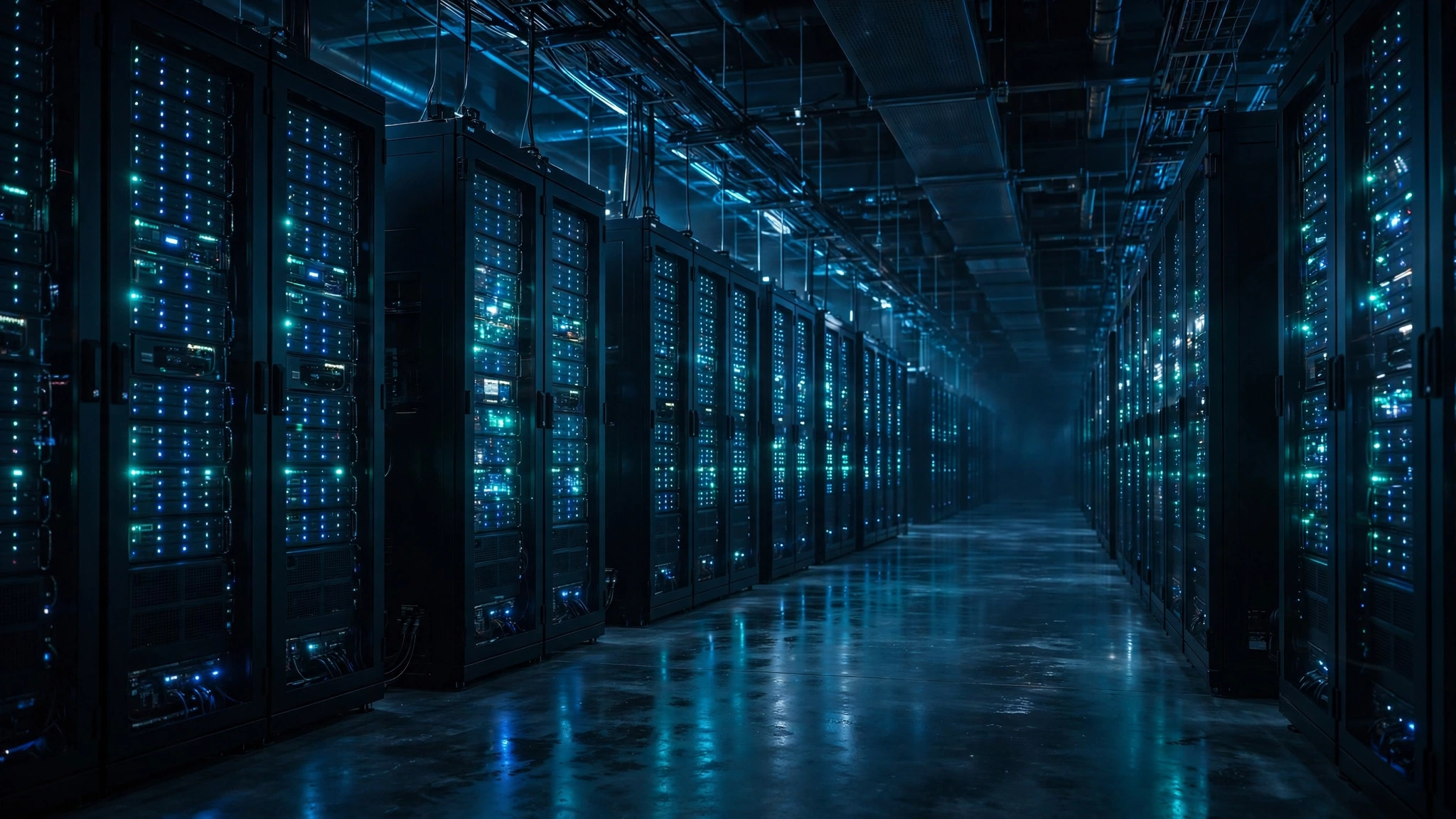
An AI data center is a facility built around thousands of graphics processors (GPUs) working in lockstep to train and run AI models. Unlike regular data centers, which run websites and apps on general-purpose chips, AI data centers are engineered for one punishing workload: the enormous, power-hungry math behind tools like ChatGPT and Claude.
You’ve seen the headlines — billions here, a gigawatt campus there — and wondered: what are AI data centers, exactly? This guide lays it out plainly: what these buildings do, how they differ from the data centers that have quietly run the internet for decades, why so many are being built, and what the real costs are.
What Are AI Data Centers, Exactly?
Start with an ordinary data center: a big, secure building full of computer servers, humming away on air conditioning, running the websites, videos, and cloud apps you use every day. An AI data center is the same idea rebuilt around a completely different job.
That job is training and running AI models. It needs thousands of specialized chips — mostly GPUs, the same kind of processors that render video games, pressed into far harder service — all working on the same calculation at the same time, in tight synchronization. NVIDIA, which makes most of those chips, has started calling the newest dedicated facilities “AI factories”: not incremental IT loads, but grid-scale consumers compressed into single massive sites.
The core difference is the workload. A regular data center juggles millions of small, independent tasks — loading a page, fetching an email, streaming a video. An AI data center runs a small number of enormous ones: teaching a model by repeating the same math billions of times, or answering millions of prompts that must respond in seconds. Everything about the building — power, cooling, networking — is reshaped around that.
How Do AI Data Centers Work?
Two very different things happen inside these buildings, and the distinction matters because it drives everything from their location to their power bill: training and inference.
Training is how models learn. A model makes guesses over massive datasets, checks how wrong it was, and adjusts its internal settings — a cycle of forward passes and weight updates called backpropagation — repeated until the model gets good. This runs for hours to months on tightly coupled GPU clusters, which is why training often sits in remote regions where power is cheap and plentiful. The numbers are staggering: training GPT-3 alone consumed an estimated 1,287 megawatt-hours of electricity — roughly what 130 American homes use in a year.
Inference is what happens when you actually use the model. Your prompt gets a single forward pass — no learning, just answering — and tokens stream back to you in seconds. Each query costs far less energy than training, but the cumulative total is enormous, because billions of queries pile up every day. Analysts at McKinsey expect inference to overtake training by 2030, accounting for more than half of all AI compute and roughly 30–40% of total data center demand.
That raises the obvious question — what are AI data centers actually made of? Here’s what happens from your side of the screen:
- You type a question into a chatbot. The request travels to the nearest AI data center running that model.
- Your prompt is broken into tokens — chunks of words — and loaded onto GPUs alongside thousands of other people’s requests.
- The GPUs run one forward pass through the model’s neural network, predicting each next token in turn.
- The tokens stream back to your screen, usually within a second or two, while the facility’s cooling systems quietly absorb the heat the calculation just produced.
Multiply that by hundreds of millions of users, and the buildings’ size starts to make sense.
AI Data Center vs Traditional Data Center
On paper these are both “data centers.” In practice, an AI facility is a different species. The table below captures the differences that actually matter.
| Traditional data center | AI data center | |
|---|---|---|
| Main chips | General-purpose CPUs | GPUs and AI accelerators, thousands per site |
| Power per rack | 5–10 kW | 30–100+ kW today; up to 480 kW planned for 2026 |
| Cooling | Air cooling, historically up to 40% of the power bill | Direct-to-chip liquid cooling, immersion — air alone can’t cope |
| Load behavior | Steady, predictable | Violent swings — 100 MW up or down in seconds |
| Typical scale | Tens of megawatts | Hundreds of megawatts to gigawatt campuses |
| Efficiency (PUE) | Industry average ~1.54–1.58 | New hyperscale builds reach 1.09–1.15 |
PUE — power usage effectiveness — is the ratio of a facility’s total power to what its computers use; 1.0 would be perfect.
A few of those rows deserve unpacking. Power density is the headline stat: a traditional server rack sips 5–10 kilowatts; a modern AI rack draws 30 to 100 kilowatts or more. NVIDIA’s GB200 NVL72 rack design packs 120 kW into a single rack, and Dell’s CTO has said the company is shipping systems at around 270 kW per rack in 2025, with roughly 480 kW planned for 2026. One projection has AI rack densities climbing from 50 kW to a full megawatt by 2029.
At those densities, air cooling hits a wall. Cooling one 120 kW rack with air alone would need air cooled below freezing or blown at near-gale speeds, so direct liquid cooling — liquid piped to within centimeters of the chips, or servers dunked in engineered fluid — has become essential. The efficiency gains are real: one peer-reviewed Microsoft study found that cooling plates plus two-phase immersion cut greenhouse-gas emissions 15–21%, energy demand 20%, and water usage 52%. Dell reports that enclosed rear-door heat exchangers can cut a 10 MW facility’s cooling energy from 2.5 MW to about 700 kW.
Then there’s the load behavior, which power engineers describe as essentially different physics at scale. AI workloads ramp tens of thousands of processors simultaneously and unpredictably, then drop just as fast, multiple times per minute. Equipment designed for gradual 20 MW swings per minute now faces 100 MW swings in seconds — a stress that can damage machinery and shorten asset life. Batteries have become the new shock absorber, sitting between the volatile load and slow-to-respond generation, and the IEA calls onsite battery storage “a critical technology for the next generation of AI data centres.”
Why Does the US Need So Many AI Data Centers?
Because demand for AI computing is growing far faster than the grid, the builders, or the chip supply can handle — and everyone is racing anyway.
The energy numbers tell the story. The International Energy Agency found that global data center electricity use hit about 415 terawatt-hours in 2024 and projects it roughly doubling to 945 TWh by 2030. 2025 was the inflection point: data center electricity demand soared 17% in a single year while global electricity demand grew just 3%, and power use from AI-focused facilities is poised to triple by 2030. In the US, the Department of Energy estimates data centers’ share of national electricity rising from 4.4% in 2023 to somewhere between 6.7% and 12% by 2028.
The money behind the buildout is just as dramatic. Capital spending by five large tech companies surged past $400 billion in 2025 and is set to rise another 75% in 2026. The four big hyperscalers — Microsoft, Amazon, Alphabet, and Meta — spent a combined $413 billion in 2025 and guided to roughly $745 billion for 2026. McKinsey puts the world on pace to invest $6.7 trillion in data centers by 2030, $5.2 trillion of it AI-specific, with chips alone accounting for about 60% of AI data center investment. US construction spending alone hit a record $59.3 billion-per-month pace in May 2026, up 129% from December 2023.
Grid connections are slow, so developers are advancing many projects with onsite natural gas generation, especially in the US — though the IEA notes those plants can be stretched by the same violent demand swings that stress the grid. Tech also accounted for about 40% of all corporate renewable power deals in 2025, and planned deals between data center operators and small modular reactor (SMR) nuclear projects grew from 25 to 45 gigawatts in 18 months.
We covered one vivid example of the scale this week: AI infrastructure company Crusoe’s $3.9 billion funding round to keep expanding its AI data center footprint.
Who Is Building AI Data Centers?
The biggest builders are the names you’d expect — Microsoft, Amazon, Alphabet, and Meta — alongside a second tier of specialists building AI-first facilities.
The flagship example is Stargate, the private-sector AI infrastructure program announced in January 2025 by SoftBank, OpenAI, Oracle, and MGX, with up to $500 billion envisioned and $100 billion committed for immediate deployment. Its first campus, built by AI infrastructure company Crusoe in Abilene, Texas, shows what “AI factory” means in practice: an 875-acre campus with eight buildings, around 4 million square feet, and 1.2 gigawatts of total power. Phase one — two buildings, over 200 MW — is already energized and serving OpenAI workloads, with phase two adding another gigawatt around mid-2026.
Each building can run up to 50,000 NVIDIA GB200 NVL72 GPUs on a single integrated fabric, cooled by direct-to-chip liquid cooling in closed-loop systems designed for zero water evaporation. A second $11.6 billion financing package funds the expansion, with roughly 7,000 workers on site daily.
Not everyone agrees the answer is simply “build bigger”: low-cost models like DeepSeek raised an honest question about whether AI progress truly requires ever-larger specialized data centers. Efficiency breakthroughs could still change the math.
What Does an AI Data Center Do to the Environment?
This is what the fastest-growing “what are AI data centers” searches are really asking about — and where vendor marketing thins out. Three resources are at stake: electricity, water, and the grid itself.
Electricity is the biggest one. As covered above, data center power demand is doubling this decade while AI-focused demand triples. The carbon impact depends entirely on where the power comes from — which is why the industry’s pivot toward renewables, batteries, and even nuclear is as much a cost-and-permission story as a climate one.
Water is the more visceral concern, and the numbers are striking. Data centers consumed 222 billion liters of water for cooling worldwide in 2025, according to Rystad Energy — and without adaptive measures, that could nearly triple to 644 billion liters by 2030. There’s a direct trade-off: cutting water use usually means spending more electricity on dry cooling instead. The big operators are improving — Microsoft cut water-use intensity 25% and AWS 37% between 2022 and 2025 — and NVIDIA claims its newest designs can nearly eliminate water use at some facilities with warm 45°C coolant that simple fans can handle.
But there’s also hidden water: the water used to generate the facility’s electricity, which in the US can be twice its own direct consumption.
A single AI campus can draw as much power as a mid-sized city — these are not trivial neighbors. That’s the context behind the moratorium debates and the rising searches asking whether AI data centers are bad for the environment: the costs land in specific places while the benefits diffuse everywhere.
What This Means Practically
For most readers, AI data centers will never be visible — but their effects are about to be. A few things worth keeping in mind:
- Your AI use has a physical footprint. Every time you chat with ChatGPT, Claude, or Gemini, your prompt runs through one of these buildings. Inference is cheap per query, but billions of queries add up — which is one reason providers are racing to make models more efficient, not just bigger.
- Electricity bills and grid debates are coming to more towns. As campuses land near communities, expect local fights over water, power rates, and land use — the “data center near me” searches are already climbing.
- The buildout won’t slow soon. With $5.2 trillion of AI-specific investment projected by 2030, transformers on 68–113-week lead times, and power infrastructure the single largest construction cost, the companies that secure power first win. Watch grid-connection news and local permitting fights for the real leading indicators.
The AI boom looks like software from the outside. Underneath, it’s construction, copper, water, and megawatts. So what are AI data centers, really? Factories — running the most power-hungry manufacturing process of the decade.
FAQ
What does an AI data center really do?
It trains AI models — running the same calculations over massive datasets for weeks or months — and then runs those trained models to answer people’s prompts. Everything in the building, from GPU-packed racks to liquid cooling to battery-backed power, is engineered around those two jobs.
Why does the US need so many AI data centers?
Demand for AI computing is outrunning supply. Global data center electricity use is set to roughly double to 945 TWh by 2030, with AI-focused facilities tripling, and hyperscalers are guiding to around $745 billion in 2026 capital spending. Each new model generation needs more compute than the last, so the building keeps accelerating.
Why do AI data centers require so much space?
Because the hardware is physically enormous at scale. A flagship campus like Crusoe’s Stargate site in Abilene, Texas spans 875 acres with eight buildings and 1.2 gigawatts of power — room for tens of thousands of GPUs per building, plus power substations, cooling plants, and battery storage, all in one place.
Who is building AI data centers?
Microsoft, Amazon, Alphabet, and Meta lead in spending, alongside AI-infrastructure specialists like Crusoe and Lancium. The Stargate program — backed by SoftBank, OpenAI, Oracle, and MGX with up to $500 billion envisioned — is building multiple campuses, starting with the 1.2 GW Abilene site.
What does an AI data center do to the environment?
Its main impacts are electricity consumption (set to double this decade globally), water use for cooling (222 billion liters worldwide in 2025), and strain on local power grids. Operators are responding with liquid cooling, closed-loop water systems, renewable power deals, and even small nuclear reactor partnerships — but the scale of growth outpaces the efficiency gains so far.
What happens to the water used by data centers?
Most of it evaporates in cooling towers or circulates in closed-loop systems. Newer closed-loop designs lose almost no water to evaporation, and NVIDIA’s newest systems use warm 45°C coolant so fans often suffice. But “hidden” water — used to generate the electricity powering the facility — can be twice the data center’s own direct consumption.
References
- International Energy Agency (IEA), “Data centre electricity use surged in 2025, even with tightening bottlenecks driving a scramble for solutions” (Key Questions on Energy and AI), 2026 — iea.org
- POWER Magazine, “AI Data Centers Demand a New Model for Power Infrastructure” (Phil Jones, Emerson), September 2026 — powermag.com
- NVIDIA Blog, “NVIDIA Blackwell Platform Boosts Water Efficiency by Over 300x,” 2025 — blogs.nvidia.com
- TechXplore (AFP), “AI data centers are less thirsty now, tech giants say,” September 2026 — techxplore.com
- Data Center Dynamics, “Crusoe secures $11.6bn in debt and equity for OpenAI’s Stargate data center campus in Abilene, Texas,” September 2026 — datacenterdynamics.com
- CRE Daily, “Data Center Construction Costs Jump 21% Since 2024” (Cushman & Wakefield 2026 guide), 2026 — credaily.com
- The Motley Fool, “How Much Are AI Companies Spending on Data Centers?” (Lyle Daly), September 2026 — fool.com
- Civo, “AI Inference vs. Training: What They Are and How They Differ,” June 2026 — civo.com
- Data Center Knowledge, “How AI Is Forcing a Rethink of Data Center Power” (James Walker), November 17, 2025 — datacenterknowledge.com
- TrendForce, “Data Center Power Doubling? Next-Gen Efficiency & Sustainability Guide,” 2026 — trendforce.com
- Reuters, “OpenAI’s Stargate AI venture is scouting for US data center sites” (Anna Tong), February 6, 2025 — reuters.com
Leave a Reply